Purple Belt Requirements

Click Here for Printer Friendly Version
1. All white, yellow, and green belt requirements.
2. Form
Name........................Yul-Gok
Number of Movements.........38
Definition.............................Yul-Gok is the pseudonym of the great philospher and scholar Yi I (1536-1584) nicknamed the "Confucius of Korea". The 38 movements of this pattern refer to his birthplace on the 38th degree latitude and the diagram(+ over -) represents "scholar".
3. Terminology
Start.....................................She-Jahk
Stop....................................Go-Mahn
Dismissed.............................Hae-Cho
School......................................Kwon
Master Instructor..............Saburn-Nim
Assistant Instructor............Gyosa-Nim
Senior Belt.....................Sun Bae-Nim
Student............................Kwon-Won
4. Meaning of the belt
purple belt means "as a grape, the ripening fruit"
5. Style of Tae Kwon Do.........................Chung Do Kwan
Chung Do Kwan means the way of the blue house.
6. Describe the Korean Flag:
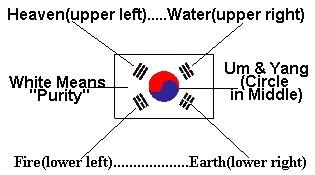
The Korean National Flag
(Tae Geug Gi)The Korean Flag symbolizes much of the thought, philosophy, and mysticism of the Orient. The symbol and sometimes the flag itself, is Tae Geug.
Depicted on the flag is a circle divided equally and in perfect balance. The upper (red) section represents the Yang and the Lower (blue) section the Um, an ancient symbol of the Universe. These two opposites express the dualism of the Cosmos: Fire and water, day and night, dark and light, construction and destruction, masculine and feminine, active and passive, heat and cold, plus and minus, and so on.
The central thought in the Tae Geug Indicates that while there is a constant movement within the sphere of infinity, there are also balance and harmony. As a simple example, kindness and cruelty may be taken into consideration. If parents are kind to a child, it is good, but they may spoil and weaken him and thus lead him to become a vicious man and a source of disgrace to his ancestors.
Three bars at each corner also carry the ideas of opposition and balance. The three unbroken lines stand for Heaven; the opposite three broken lines stand for Earth. At the lower left hand corner of the flag are two lines with a broken line between. This symbolizes fire. The opposite is the symbol for water.
7. Performance:
Forms
One-steps
Sparring
Knowledge